Wheelchair-Accessible Iceland: What Works, What Doesn't, and What We Do Instead
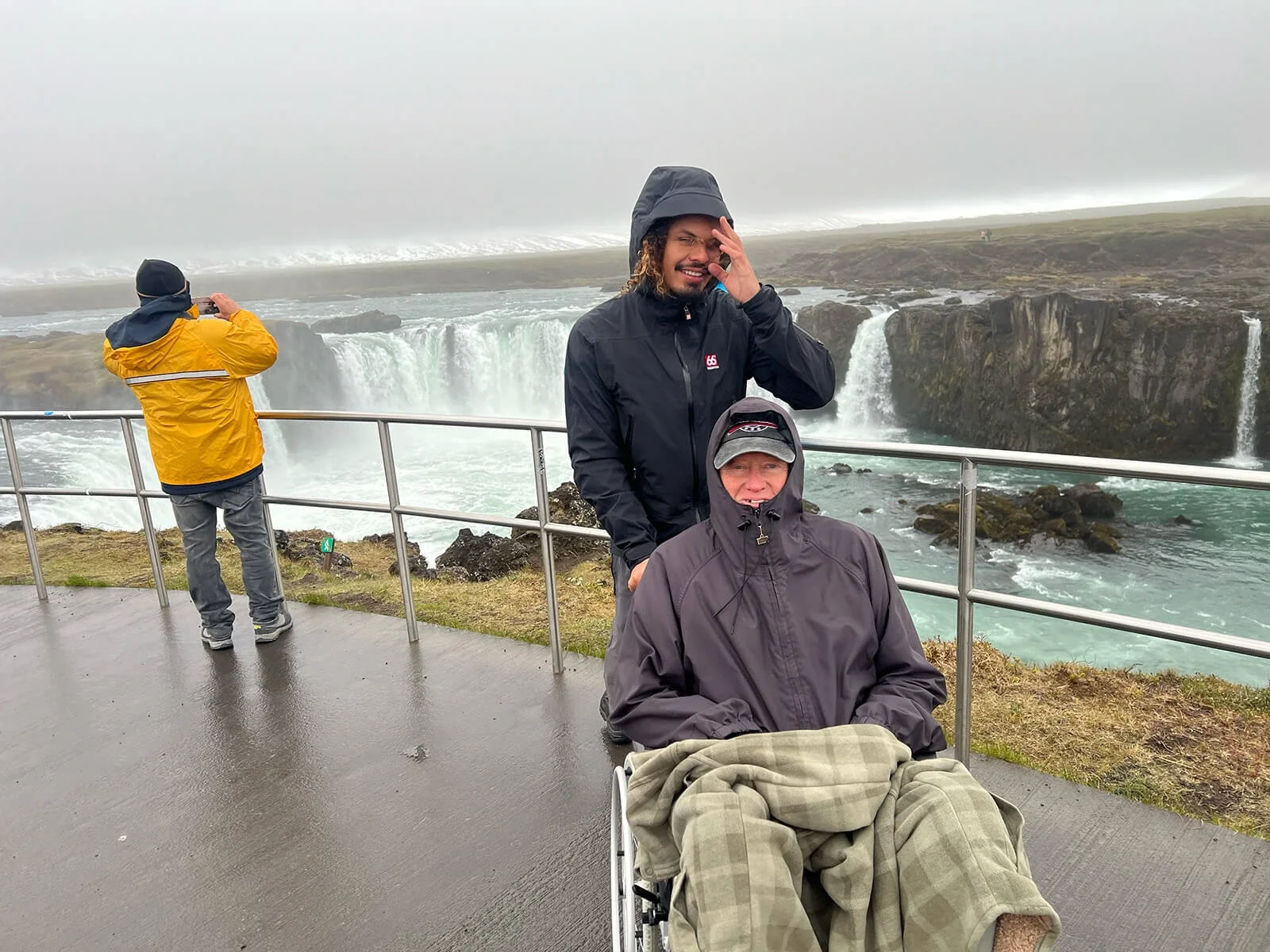
These are some of the lessons I have learned during my years as a private tour guide in Iceland: which places are truly accessible, which ones present real difficulties, and what we have done to adapt the experience when the terrain does not allow for conventional access.
Iceland is not a destination built with universal accessibility in mind. Many of its most spectacular landscapes sit on natural, uneven terrain that is hard to adapt, but that does not mean a person in a wheelchair cannot enjoy Iceland.
After years organizing private trips for travelers with reduced mobility, we have learned to tell the difference between what is genuinely possible, what needs assistance, and what calls for finding an alternative.
What is actually accessible
These are some of the places where accessibility is real, letting you enjoy the landscape without having to face particularly difficult terrain.
-
On the Reykjanes Peninsula, boardwalks and ramps let you get close to the steam vents without having to cross uneven ground.
-
In the Golden Circle, some of the main areas have paved paths and prepared surfaces that make access easier. You can enjoy part of the Almannagjá rift landscape without needing to cover difficult natural terrain.
-
The area around the geyser has wide paths and compacted surfaces that let you get close to the geothermal field and enjoy the geyser's eruptions.
-
The upper viewpoint is one of the best ways to enjoy Gullfoss, one of the main stops on the Golden Circle, with reduced mobility. It has a prepared area with access to both the views and the visitor center.
Keep in mind that not the entire route around the waterfall is accessible. The path down to the lower areas has slopes and steps, so it is not suitable for every wheelchair user.
What is not fully accessible, and what we do instead
We do not want to simply say a place is "accessible" just because a platform exists, or because someone can reach a certain point. We want to explain how far you can actually get, and what alternatives exist where the terrain has a limitation.
-
The route around the crater offers good views from the upper areas, but going down to the inner lake means more difficult terrain and stairs.
For a person in a wheelchair, our recommendation is to enjoy the crater from the accessible areas at the top.
-
You can get close to the waterfall from the front, but the path behind it has much more difficult terrain, with uneven surfaces, rocks, and slippery patches.
Because of that, for a person with reduced mobility, the experience can center on enjoying the waterfall from the front, without attempting the route behind it.
-
The lower area lets you get close to the waterfall, although the gravel and small stones can make it harder for a manual wheelchair to move without assistance.
The stairs leading up to the higher viewpoint are not a suitable option for a wheelchair.
-
Reynisfjara's black sand beach presents one of the clearest problems: the sand is deep and loose, so wheels can sink easily.
Dyrhólaey also has slopes and natural surfaces that can make access considerably harder.
In these cases, the question should not simply be "is it accessible?" but rather:
"What part of this place can we enjoy safely and comfortably?"
The Highlands and the glaciers: when conventional access is not enough
Iceland's Highlands and its glaciers are probably the clearest examples of places a wheelchair cannot reach the same way it can reach an attraction with a paved boardwalk.
There are 4x4 only tracks, rocky terrain, river crossings, and ice surfaces that make access by land extremely difficult or simply not viable, depending on conditions and on the traveler's needs.
But this is exactly where adapting the trip changes what is possible.
-
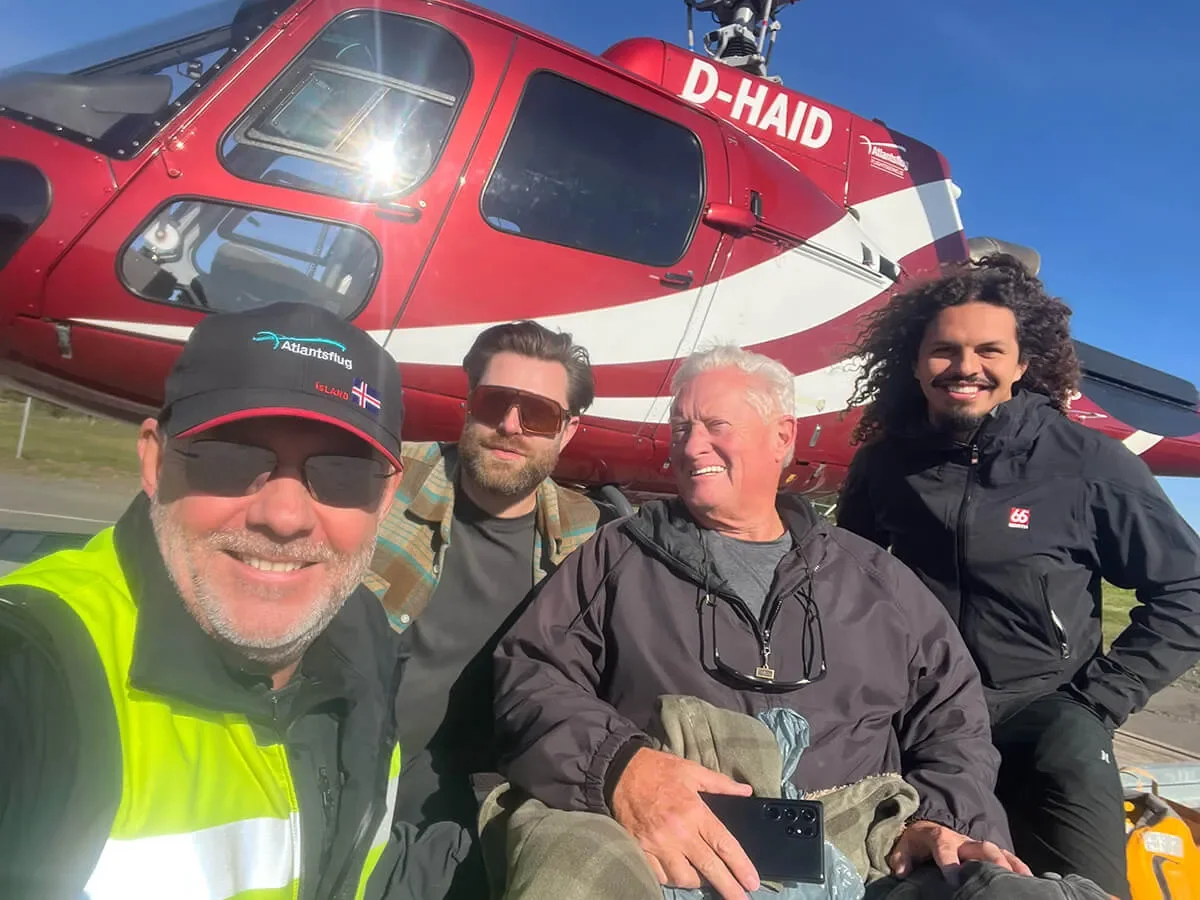
In our case, we have used helicopters so travelers with reduced mobility could enjoy parts of the Highlands and areas close to glaciers.
On our 12 day trip with a guest in a wheelchair, we used two helicopter flights specifically to reach places that could not be reached the conventional way.
-
Accessibility does not end once you arrive at a landmark. You also have to think about everything that happens between one place and the next.
We run private tours using our own luxury vehicles, including the Mercedes V Class and Sprinter, and we choose the vehicle based on each group's needs.
That means thinking about space for a wheelchair or any other mobility aid, comfort on long drives, and how easy it is to get in and out of the vehicle.
Transfers should not be left to improvisation either. Our team has experience helping guests get a wheelchair in and out, and moving the necessary equipment at each stop along the trip.
The idea is that the traveler should not have to constantly worry about how they will get from one place to the next.
What is the best time of year for an accessible trip to Iceland?
In our experience, summer, especially from mid June through late August, tends to offer the easiest conditions for a trip like this.
There is less chance of finding ice or snow on many of the paths, and daylight hours are extremely long. This makes it possible to build a more flexible itinerary and avoid the busiest hours at some locations.
It is also worth keeping in mind that Iceland's weather stays changeable even in summer. Wind, rain, and terrain conditions can affect the experience, so a good itinerary should always leave some room to adapt.
May and September can bring fewer visitors, but they can also bring more unpredictable weather.
There is no single perfect date for everyone. The best time will also depend on the traveler's specific needs and the kind of experience they want to have. Before booking, here are the questions you should ask any accessible tour operator.
Is Iceland wheelchair accessible? The honest answer
"Iceland isn't for people in wheelchairs" We hear this a lot, and it is not true. But it would not be honest to say that all of Iceland is accessible either.
Iceland has natural landscapes that simply were not designed with a wheelchair in mind. There are sand beaches, rocks, ice, rivers, and paths where conventional access is not possible.
At the same time, there are many places where a person with reduced mobility can fully enjoy the landscape, especially when the itinerary is well planned.
And when a place is not accessible by land, sometimes there is another possibility.
That is what we have learned after years organizing private trips: accessibility means knowing exactly what is possible, what is not, and what we can do to find an alternative.
Because an accessible trip should not be about adapting the traveler to Iceland. It should be about adapting Iceland to the traveler.
Ready to plan your accessible Iceland trip? See how we adapt every tour
Read the story of a 12-day wheelchair tour in Iceland